Gravity multimodal HMI
Pre-production and program-long research that influenced Gravity's final UI direction, steering wheel controller design, app interaction model, and HUD/ARHUD experiences, contributing to an iF Gold Award-winning interaction system and a patent expected to grant soon.
Summary
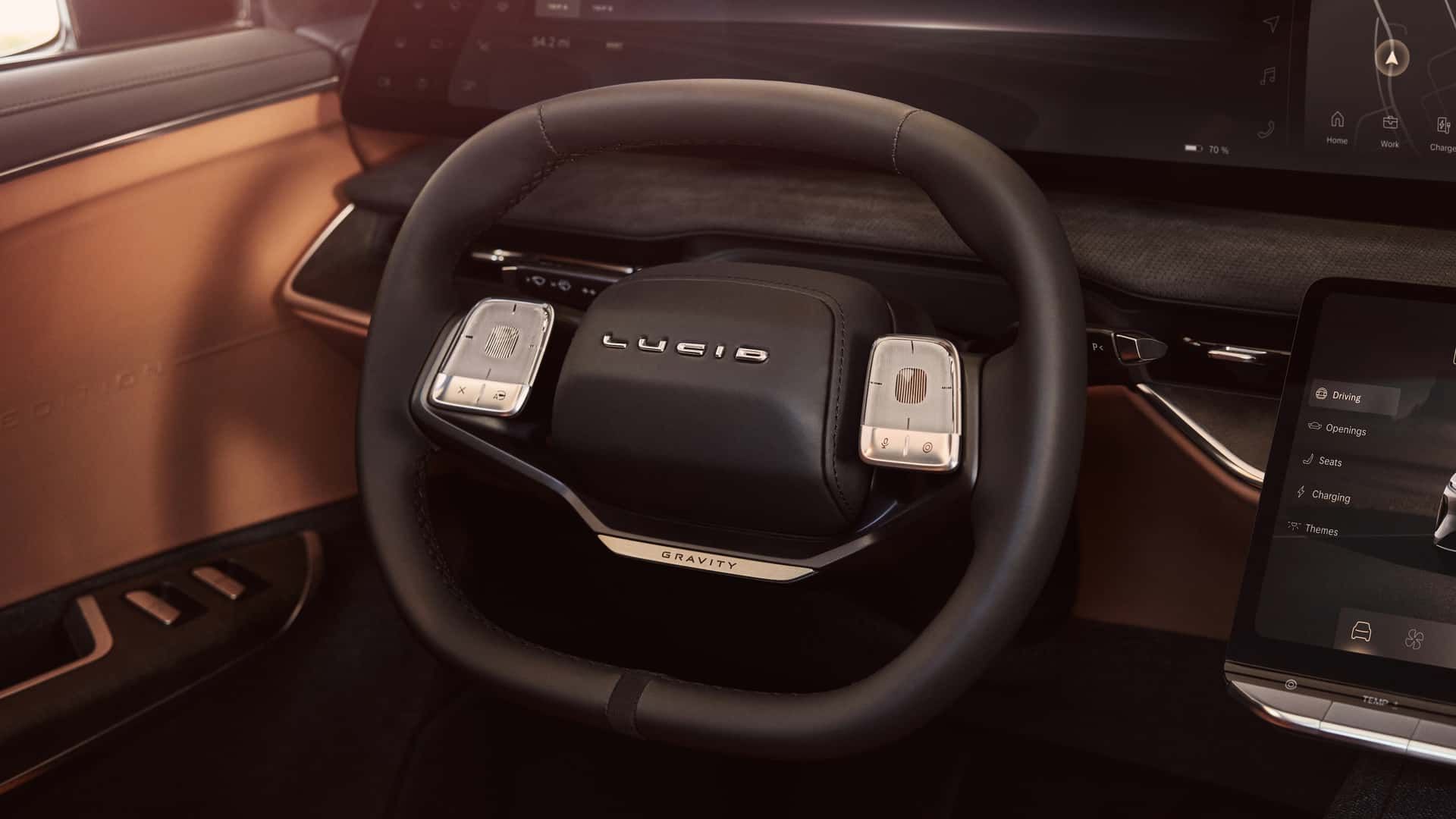
Multi-year program-long research on Lucid Gravity’s multimodal HMI: the physical and digital interaction system across screens, voice, steering wheel controller, tactile feedback, and head-up displays. Across five distinct studies between 2023 and 2025, the work shaped the app interaction model, validated steering wheel hardware decisions, surfaced pre-production usability findings in time to make changes before launch, and informed HUD design.
The scope of the work
A modern luxury vehicle has an interaction system, not a set of separate interfaces. Screens, voice, steering wheel controls, tactile feedback, head-up displays. The research had to make decisions that worked across all of them, on tight pre-production timelines, where the cost of finding the wrong answer late is high.
iF Gold Award and patent
Gravity’s multimodal interaction system received an iF Gold Award in 2024. I contributed research-led design direction and validation across the program, working alongside design and engineering teams who carried the interaction system to launch. I’m a co-inventor on a patent for the Gravity multimodal interaction system, with the grant expected soon.
App interaction model: the cross-screen study (April 2023)
Early in the program, I led a lab-based usability and co-creation study with 8 participants on how the app interaction model should work across Gravity’s instrument cluster, central display, and steering wheel controller. Using quantified consensus reporting, it drove specific decisions on cross-screen parity, source-change behavior, and incoming-call affordances; a participant suggestion for hands-on-wheel browsing seeded the next study in the program.
Steering wheel interaction model: the Detection Response Test study (December 2023)
The hands-on-wheel browsing concept that came out of the cross-screen study needed empirical validation. Was it actually safer than touchscreen interaction? I led a two-part study using a static-rig adaptation of the Detection Response Test, an industry-standard human-factors method for measuring driver distraction, with 19 participants in a within-subjects design comparing three interaction modes.
The headline finding was a perceived-versus-measured-safety mismatch. The interaction model participants preferred (the hands-on-wheel mode) measured as the most distracting on every objective metric: slower task completion, more delayed responses, more missed cues than the touchscreen baseline. The mode that felt less safe (touchscreen) measured as fastest and least distracting. The follow-up qualitative study identified the specific causes (timeout duration, one-at-a-time navigation friction, attention pull from the highlight box) and produced recommendations that informed how the final interaction model balanced safety, speed, and discoverability.
Steering wheel controller hardware: a late-stage study (December 2024)
Late in pre-production, an aspect of the controller’s physical design was still being decided. I led an A/B comparative study with 9 participants across parked and driving conditions, testing whether a proposed hardware change would reduce error rates and improve eyes-off operation enough to justify it.
The findings were unambiguous: the proposed change substantially reduced accidental inputs and let participants locate controls without visual confirmation, and 8 of 9 preferred it. The recommendation informed the controller hardware decision. Research-driven hardware changes at that stage of a program are rare; they happen only when the evidence and the safety stakes are both unambiguous, which here they were.
Pre-production usability: the soft-launch study (December 2024)
Just before Gravity’s soft launch, I led a comprehensive pre-production usability evaluation across more than fifteen interaction flows, a mixed-methods design with 11 participants. Twelve top-line recommendations came out of it, most implemented before Gravity reached customers, including the retention of physical HVAC controls and pre-launch fixes to EV charging button placement, camera tint, and frame rate.
HUD and ARHUD research (March–June 2025)
The program also included usability research on Gravity’s 2D head-up display and an augmented-reality HUD program, pairing on-road testing with benchmarking against established luxury HUD systems. It produced acceptance-criteria-level recommendations on sunlight legibility, ADAS indicator semantics, and the role of subtle vibration as a quality signal.
Credible research can change hardware late in a program
Late-stage HMI research is a specific discipline. It runs against tight schedules, against decisions that have already been made, against engineering constraints that aren’t always flexible. To be useful, it has to produce findings precise enough to act on, fast enough to act before windows close, and credible enough that hardware teams will accept design changes when the evidence is strong.